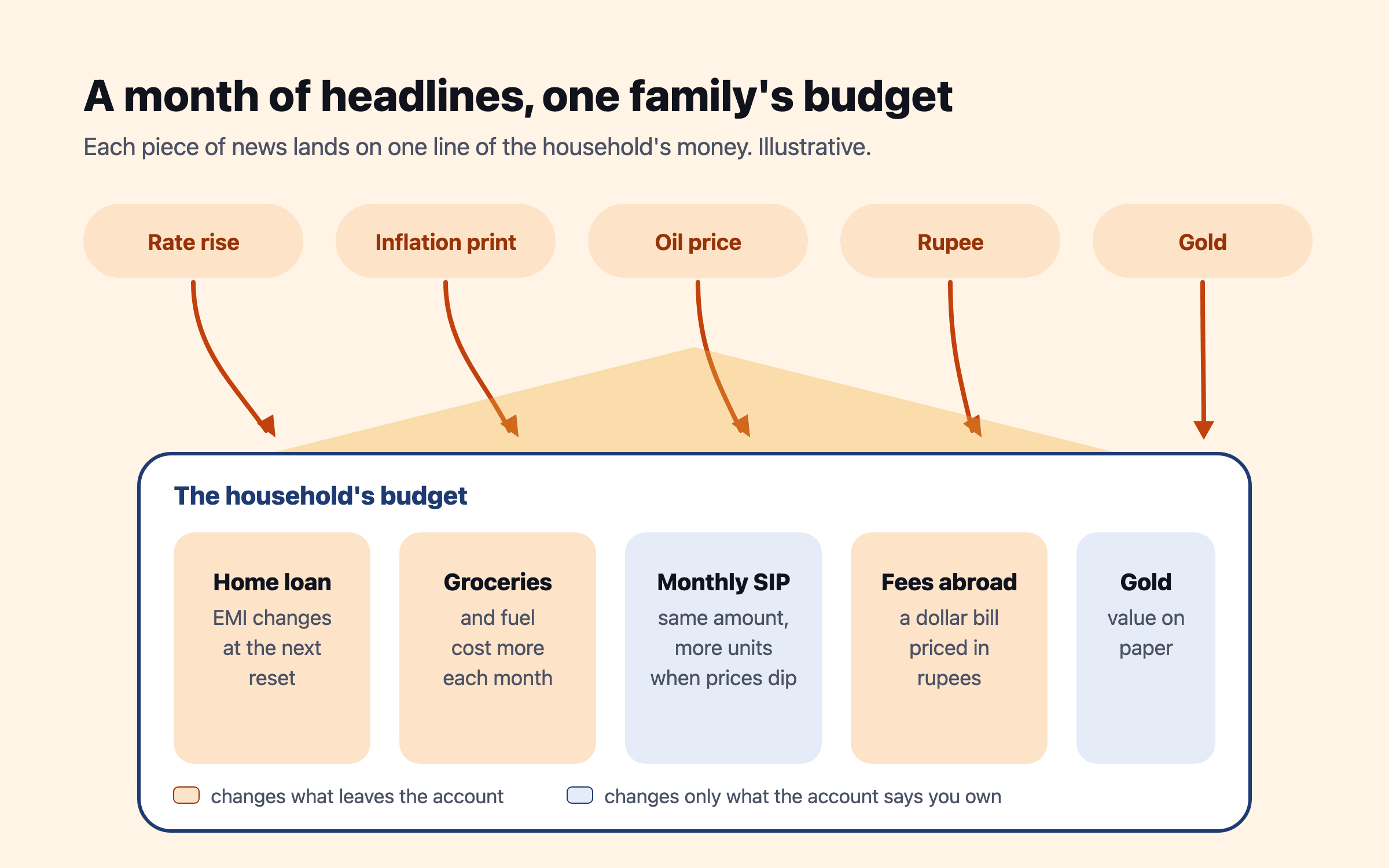
October 2026 brought a rate rise, a 5.54% inflation print, oil above $110 and a rupee near its low, and for most families only a few of those headlines reach the budget.
In October 2026 the RBI raised its repo rate to 5.50%, Indian inflation reached 5.54% and US gasoline cost 34.2% more than a year earlier. For one illustrative Pune family the loan EMI rose by about ₹772 a month and groceries by about ₹1,548, while a dollar fee bill moved by lakhs. Who is really hit depends on what you owe, what you must pay soon in another currency, and when you need to sell.
Nivritee Research · 21 October 2026 · 11 min read
The short answer: most of October’s headlines change a household’s paper wealth, not its monthly cash. The ones that reach the budget are narrower. The RBI raised its repo rate by 25 basis points to 5.50% on 7 October, and SBI passed that on to repo-linked home loans from 15 October1,2. Food prices in India were 7.74% higher than a year earlier in September3. And anyone paying a bill in dollars saw the rupee touch 96.78 to the dollar on 8 October before recovering to 94.46 by 21 October4. If you hold a floating-rate loan, a foreign-currency bill due soon, or a plan to sell investments in the next year or two, this month touched you. If you are saving for something twenty years away, it mostly made noise.
Meera and Arjun live in Pune. They are illustrative, with round figures, but their month will be familiar. Between them they bring home ₹2,00,000 a month. They owe ₹50 lakh on a home loan linked to the repo rate, at 8.50% with 18 years left. They put ₹25,000 a month into an equity fund by SIP, keep ₹10 lakh in fixed deposits, and hold 100 grams of gold, much of it jewellery from their wedding. Their daughter hopes to start a master’s degree in the US next autumn, at about $40,000 for the first year. Their loan rate sits inside the 7.50% to 8.80% range SBI now charges on regular home loans2. These figures are chosen to make the arithmetic easy to follow, not to describe anybody real.
October gave them a lot to read. Brent crude for physical delivery jumped 18% in a single day, from $114.82 a barrel on 1 October to $135.51 on 2 October, then spent the rest of the month sliding back to $117.37 by 21 October7. Brent futures, the price most news quotes, had ended September at $98.03 and stood at $110.77 on 21 October8,9. The RBI raised rates on 7 October. September’s inflation figures came out in India on 12 October and in the US on 14 October3,5. Gold, after falling 8.5% in September, kept drifting lower in rupees10,11. On 21 October itself, the Nifty 50 closed at 22,811.35, with small companies’ shares down 2.37% in a day as oil and Middle East tensions weighed again9.
Brent crude, physical cargoes, US dollars a barrel, each trading day from 1 to 21 October 2026.
The price of a physical Brent cargo (the EIA’s spot series). Futures traded lower, because buyers paid a premium for oil that could be loaded now: the December contract stood at $110.77 on the afternoon of 21 October. Either way, the swing inside one month was large. 7,9The figures in this chart
Brent spot price, $ a barrel
1 Oct
$114.82
2 Oct
$135.51
5 Oct
$125.51
6 Oct
$125.44
7 Oct
$126.00
8 Oct
$130.18
9 Oct
$130.03
12 Oct
$129.95
13 Oct
$125.78
14 Oct
$126.55
15 Oct
$126.35
16 Oct
$119.33
19 Oct
$118.82
20 Oct
$115.22
21 Oct
$117.37
None of that is a reason to do anything on its own. What matters is where each headline lands in the household’s own money. The rest of this article follows each one down to a line of the budget, and asks a plain question of every line: does this change what leaves our account each month, or only what our accounts say we own?
The rate rise and the home loan EMI
The RBI’s Monetary Policy Committee raised the repo rate from 5.25% to 5.50% and changed its stance to “calibrated tightening”, citing a weak monsoon, high energy prices and inflation that was broadening across the shopping basket. Its minutes, published on 21 October, say rate cuts are off the table in the near term, and it now projects inflation of 5.2% for 2026-271. For a borrower the important word is “linked”. SBI raised its repo-linked and external-benchmark lending rates by 25 basis points from 15 October, putting its regular home loans at 7.50% to 8.80%2.
The standard EMI formula on an illustrative loan. If the bank keeps the EMI the same and lengthens the loan instead, it runs about nine months longer, and those extra EMIs add up to roughly ₹4.2 lakh. 2,1
Meera and Arjun’s loan
Before
After
Outstanding balance
₹50,00,000
₹50,00,000
Rate
8.50%
8.75%
Months left
216
216 (if the EMI changes)
Monthly EMI
₹45,273
₹46,045
Extra each month
₹772
Extra over a year
₹9,260
Or: same EMI, longer loan
216 months
about 225 months
So the headline “RBI hikes rates” costs this family about ₹772 a month, or roughly 0.4% of what they bring home2. That is real money, and it is also not a crisis. The detail many borrowers miss is the second option in the table. Banks may keep the EMI the same and stretch the loan instead, which feels like nothing happened. It is the costlier route over the life of the loan: about nine extra months of payments, around ₹4.2 lakh in total, on a balance that has not changed2. Ask your bank which one it applied, and when your loan resets. The RBI’s rules say a loan priced off an external benchmark such as the repo rate must be reset at least once in three months, so the change may not appear until your next reset date12.
In the US the same pressure shows up differently. The Federal Reserve raised its target range to 3.75% to 4% in September, its first rise since 2023, and before September’s inflation figure came out, futures already priced a further rise by the year’s end13. Most American homeowners hold a fixed 30-year mortgage, so their payment does not move at all. The people hit are those buying now. Freddie Mac’s weekly average for a 30-year fixed loan was 7.40% on 15 October, against 6.27% a year earlier14. For Dana in Austin, an illustrative buyer borrowing $400,000, that is a monthly payment of about $2,770 instead of about $2,468, roughly $301 more for thirty years14.
Inflation at the grocery till and the petrol pump
India’s retail inflation rose to 5.54% in September from 4.83% in August, and food inflation was 7.74%, up from 5.97%, with onions more than twice the price of a year earlier15,3. Transport costs were up 5.01%3. If Meera and Arjun spend ₹20,000 a month on groceries, prices like September’s mean about ₹1,548 more each month than a year ago; if they spend ₹8,000 on getting about, about ₹401 more3. Unlike the EMI, these rises do not reverse when a central bank acts. They are the part of a volatile month that stays.
In the US the cost came through the pump. Consumer prices rose 3.7% in the year to September, but energy was up 20.4% and gasoline 34.2%, while food at home rose only 1.8%5. A household that spent $200 a month on gas a year ago is spending about $268. In Thailand, headline inflation reached 2.82% in September and energy alone contributed 1.85 percentage points of it, as fuel prices stayed above last year’s because of the Middle East conflict16. The pattern is the same in each country: oil is the story, and the family that drives most or heats most feels it most.
The rupee and a dollar fee bill
On 7 October the rupee came close to its record low of 96.96 to the dollar, set in May, as high oil prices and a strong dollar pushed against it17. FRED’s noon rates show 96.78 on 8 October and 94.46 on 21 October, against 87.97 a year earlier4. For a family with a bill in dollars, this is the headline that matters most, by a long way.
By a number of estimates, including the REER, the rupee is not overvalued; it may be undervalued.
The same dollar bill at three rates. Against a year earlier the rupee cost of the first year rose by ₹2,59,600, about 7.4%; within October alone the swing was ₹92,800. 4
Exchange rate
Rupees per dollar
Cost of a $40,000 first year
A year earlier, 21 October 2025
87.97
₹35,18,800
Weakest day of the month, 8 October 2026
96.78
₹38,71,200
21 October 2026
94.46
₹37,78,400
That is the difference between this headline and the others: on a $40,000 fee, the rupee’s fall over a year added about ₹2.6 lakh, about twenty-eight times what the rate rise adds to their EMI in a year4,2. The swing inside October alone, ₹92,800, was about ten years of the loan rise4. Families in the Gulf saw the mirror image. The same weak rupee meant each dirham or riyal sent home bought more rupees, which helped those paying for a home or a parent’s care in India, and a recovering rupee in the second half of the month quietly took some of that back17,4. If your child’s fees are due within a year, the move is real. If they are ten years away, it is one point on a long line; the rupee over 25 years shows how that line has run.
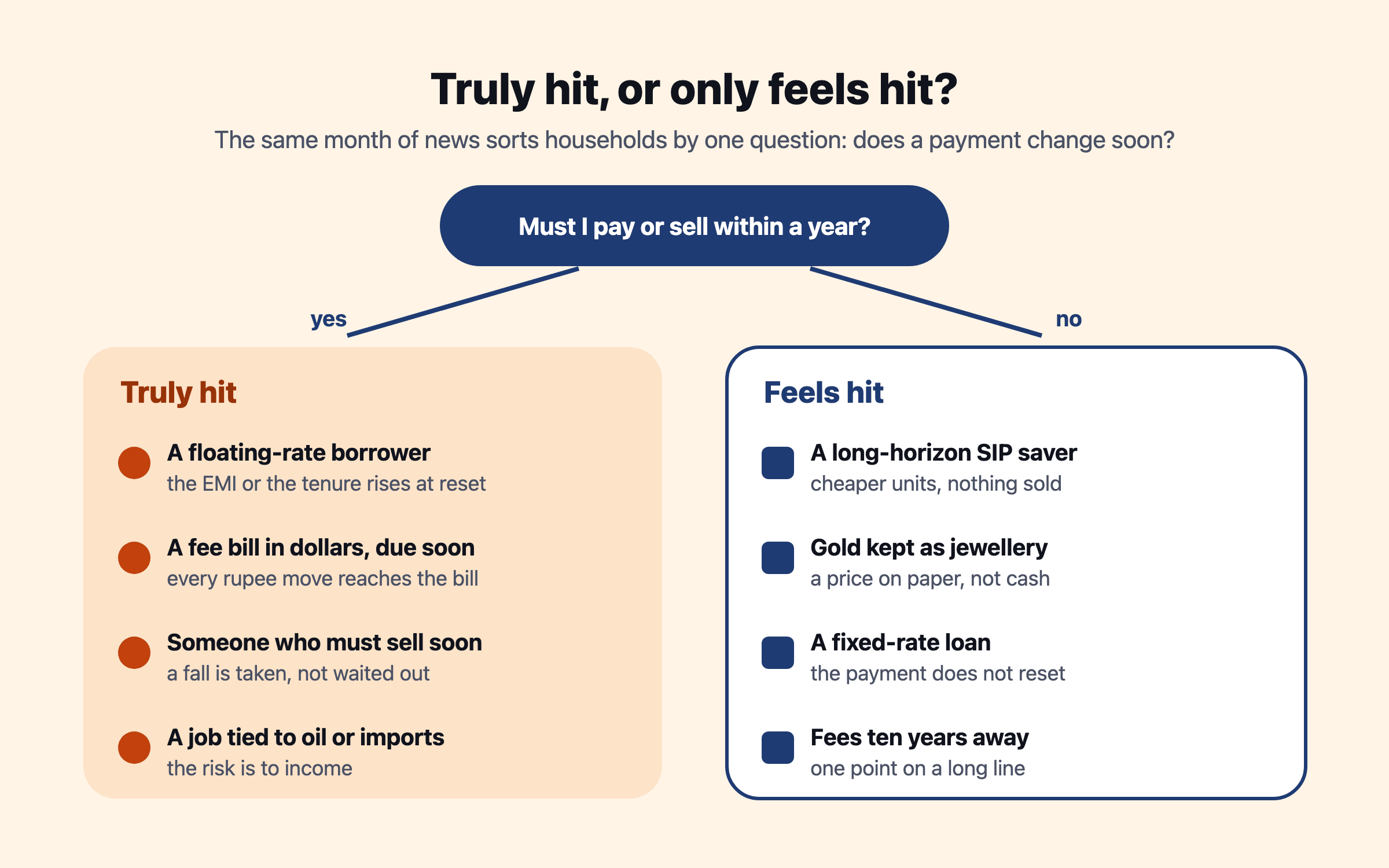
The same headline sorts households into two groups. The question is not how big the move was but whether it changes a payment you must make soon.
The SIP, the shares and the gold
Meera and Arjun’s equity fund probably fell on the bad days and recovered on others; the Nifty 50 ended 21 October at 22,811.35 after a day when mid-sized companies fell 1.58% and small ones 2.37%9. Their SIP of ₹25,000 went in as usual, and when prices are lower the same rupees buy more units. Indian savers as a whole behaved that way: SIP contributions reached a record ₹32,490 crore in September, and money into equity funds rose nearly 31% on August6. For a family saving for something a decade or more away, a falling month is a month of cheaper units, not a loss they have taken.
Gold felt different because Indian families watch it. The World Gold Council reported that gold fell 8.5% in September to $4,176 an ounce, as US bond yields and the dollar rose10. In rupees the benchmark rate for 10 grams was ₹1,49,880 on 1 October and ₹1,46,630 on 21 October, about 2.2% lower18,11. At the 24-carat benchmark rate, Meera and Arjun’s 100 grams went from about ₹14,98,800 to ₹14,66,300 on paper, a fall of ₹32,500; jewellery, usually 22 carat, is worth somewhat less18,11. They have not lost ₹32,500 of anything they were going to spend. Much of that gold is jewellery they intend to keep; gold over 50 years shows how long its quiet stretches and sharp falls have lasted.
An illustrative household. The useful question about gold is not its price this week but its share: here about a quarter of everything held, much of it in a form that will not be sold. 11
What they hold
Value on 21 October
Share
Equity fund (SIP)
₹35,00,000
58.7%
Gold, 100 grams, at the 24-carat rate
₹14,66,300
24.6%
Fixed deposits
₹10,00,000
16.8%
Total
₹59,66,300
100%
Where gold does matter is the share. A quarter of everything held in one metal is a large bet on one price, and a month in which that price falls 2% in rupees after 8.5% in dollars the month before is a reminder of what a quarter means11,10. The time to decide whether that share is right is a calm one, with your plan in front of you, not the week the price moves.
Who is truly hit, and who only feels it
Put the month together for Meera and Arjun and measure each change against a year’s take-home pay of ₹24 lakh. The loan adds ₹9,260 a year, groceries about ₹18,576 and transport about ₹4,810, so the three cash changes together come to about 1.4% of what they earn2,3. The gold’s paper fall is a similar size but is not cash at all11. The dollar fee bill dwarfs everything else: ₹2,59,600 more than a year earlier, nearly 11% of a year’s pay, due within a year4.
How each October headline changed Meera and Arjun’s year, as a share of a year’s take-home pay.
Illustrative: one household’s own arithmetic, from the worked examples above. The fee bill is a cash payment due within a year; the gold figure is a change in the value of something they intend to keep. The figures in this chart
% of a year’s take-home pay
Dollar fee bill, first year
10.82%
Gold, change on paper
1.35%
Groceries, a year of food inflation
0.77%
Home loan EMI, a year
0.39%
Transport, a year
0.20%
That gives a fair way to sort any household. The people truly hit by a month like this are three groups. Borrowers on floating rates, whose payments rise at the next reset. Families with a bill in another currency due soon: fees abroad, a parent’s treatment, a flat being bought in another country. And anybody who has to sell investments in the next year or two, because they are selling after a fall rather than waiting for a recovery. A fourth group is worth naming: people whose jobs depend on oil prices or on imports, such as chemicals makers, whose Nifty index fell 2.64% on 21 October alone9. For them the risk is to income, which is why an emergency fund matters more than any portfolio move.
Everybody else mostly feels hit. A long-horizon saver watching a fund fall for a week has lost nothing they were about to spend; what changed is a number on a screen. The feeling is real, and so is the urge to act on it at 2am with the app open. It helps to say out loud which group you are in, line by line. Most households are in the first group for one or two lines and in the second for the rest.
What to do this month, and what not to
Find your loan’s reset date and ask the bank whether a rise will change your EMI or your tenure. If it lengthens the loan, consider asking for the EMI to rise instead, which costs less over the life of the loan.
If you owe a bill in another currency within a year, decide how much of it to set aside now in that currency or in a deposit kept apart for it, rather than waiting to guess the best day.
Price your grocery and fuel lines again from your last three months of spending, not from last year’s figure. That is the part of inflation that stays.
For a goal a decade or more away, stopping a SIP usually costs more than it saves: a month of lower prices buys more units for the same money.
Look at your gold and your equity as a share of everything you hold. If a share is larger than you would choose on a calm day, plan to change it over months, not this week.
If your income depends on oil or imports, check your emergency fund covers several months of essential spending before you do anything else.
What not to do is shorter. Selling a long-term investment because of one month’s news rarely helps. Pausing a SIP to “wait for clarity” waits for something that never arrives on a date. Buying gold because it just fell, or anything because it just rose, is a bet on the next month, not a plan. And prepaying a loan from your emergency money is riskiest in a month when your job might be the thing at risk. If a month like this makes you want to change your whole approach, that is a sign the approach was never written down. Market crashes and recovery times and recessions, jobs and markets set out what the long record says.
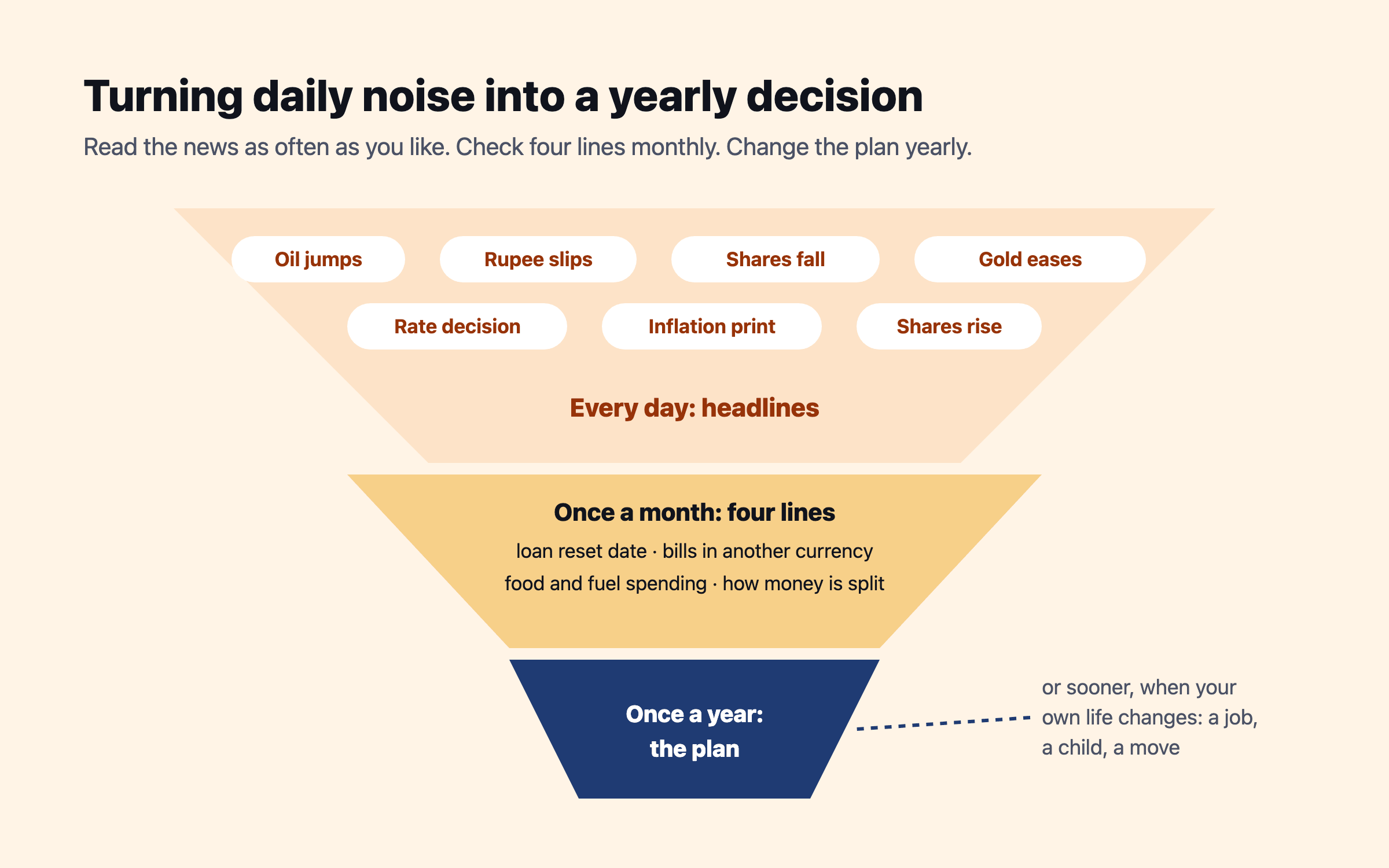
A way to stop the noise: read the news daily if you like, check four lines once a month, and change the plan once a year or when your own life changes.
How to stop the noise causing stress
The stress of a month like October comes less from the size of the moves than from not knowing which of them matter to you. A rate rise, a 5.54% print and physical Brent swinging by about $20 in a day all arrive with the same urgency3,7. The cure is to decide in advance what you check and how often. Once a month: your loan’s next reset, any bill due in another currency, your food and fuel spending, and how your money is split. Once a year, or when your life changes: the plan itself. Between those dates the app can stay closed.
It also helps to know what your plan already assumes. A plan that projects 7% inflation on food for a decade is not broken by one 7.74% month; one that assumes the rupee never falls is broken by every year3. If you can see your own numbers tested against a sustained inflation run or a crash, the next headline has somewhere to land. Meera and Arjun’s honest answer for October was that two lines changed (the loan by ₹772 a month and the fee bill by lakhs) and they needed to act on one of them: setting money aside for their daughter’s first year. The rest was a month worth reading about, and not a month worth acting on2,4.
Questions people ask
How much will my home loan EMI go up after the RBI rate hike?
For a repo-linked loan the rise usually follows at your next reset. On an illustrative ₹50 lakh loan with 18 years left, a move from 8.50% to 8.75% raises the EMI by about ₹772 a month; if the bank lengthens the loan instead, it runs about nine months longer2.
Should I stop my SIP when the market falls?
For a goal ten or more years away, stopping usually hurts: a lower price buys more units for the same money. Indian savers kept going in September, when SIP contributions reached a record ₹32,490 crore6.
How does a falling rupee affect US college fees?
Directly. A $40,000 first year cost about ₹35.2 lakh at 87.97 rupees per dollar a year earlier and about ₹37.8 lakh at 94.46 on 21 October 2026, about 7.4% more4.
Why did gold prices fall in October 2026?
The World Gold Council linked September’s 8.5% fall in dollar terms to rising US bond yields, a stronger dollar and investors cutting futures positions; in rupees the 10-gram benchmark eased from ₹1,49,880 on 1 October to ₹1,46,630 on 21 October10,18,11.
Is inflation going up in India?
Retail inflation rose to 5.54% in September 2026 from 4.83% in August, with food at 7.74%, and the RBI projects 5.2% for 2026-273,1.
What should I do when the stock market is volatile?
Sort each move into one that changes a payment you must make soon and one that only changes a value on a screen. Act on the first kind (loan resets, bills due in another currency, an emergency fund if your job is exposed) and leave long-term investments alone.
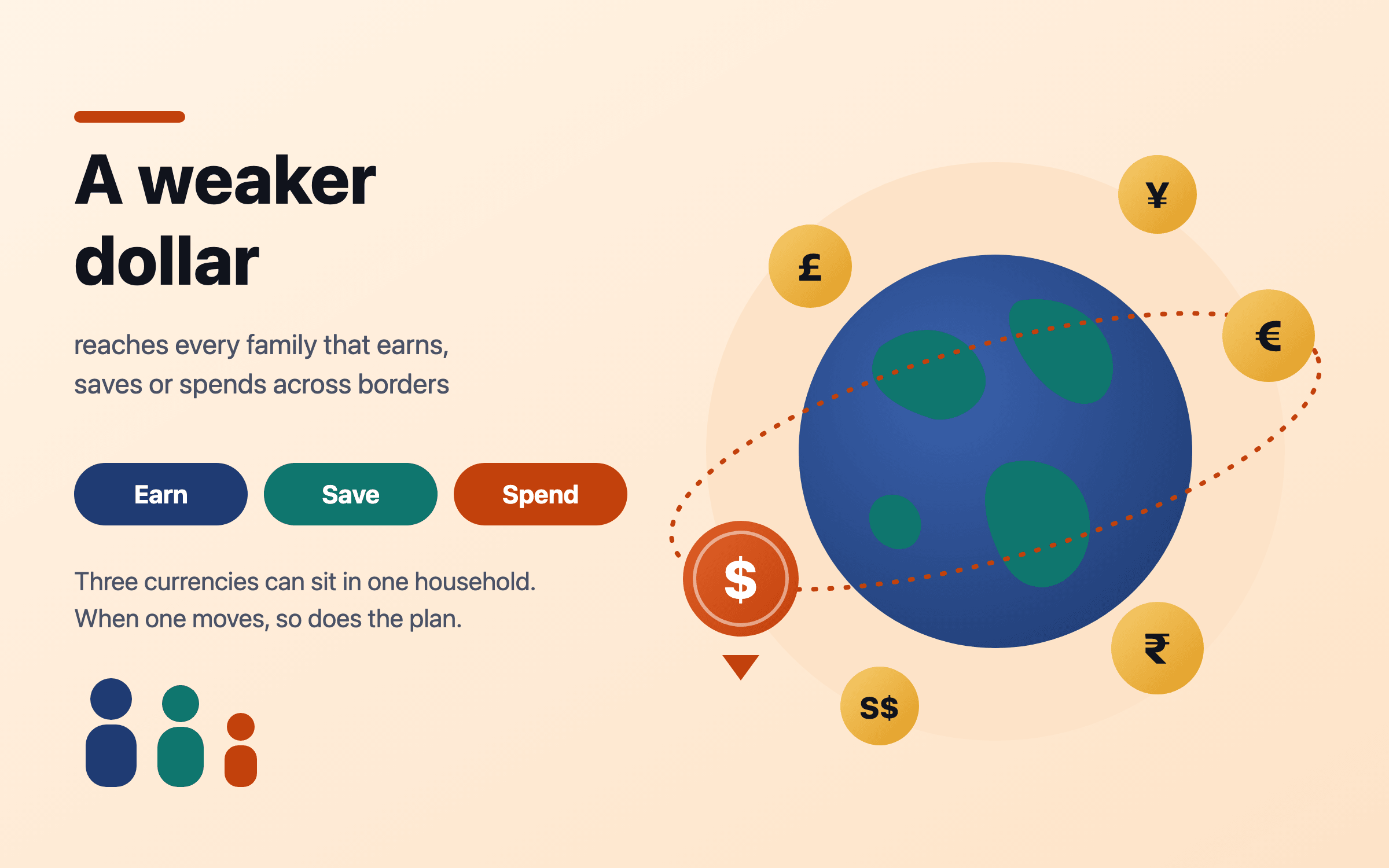
The US dollar index fell 10.8% in the first half of 2025, its worst start to a year since 1973, and the Fed’s broad dollar index ended 2025 down 7.4%. In 2026 the dollar steadied, and the rupee fell to record lows near 97 as oil surged. The same S&P 500 returned 16.4% in dollars in 2025, 2.7% in euros and 22.2% in rupees. What matters for a family is not which way the dollar moves but whether its savings are in the currency it will spend.
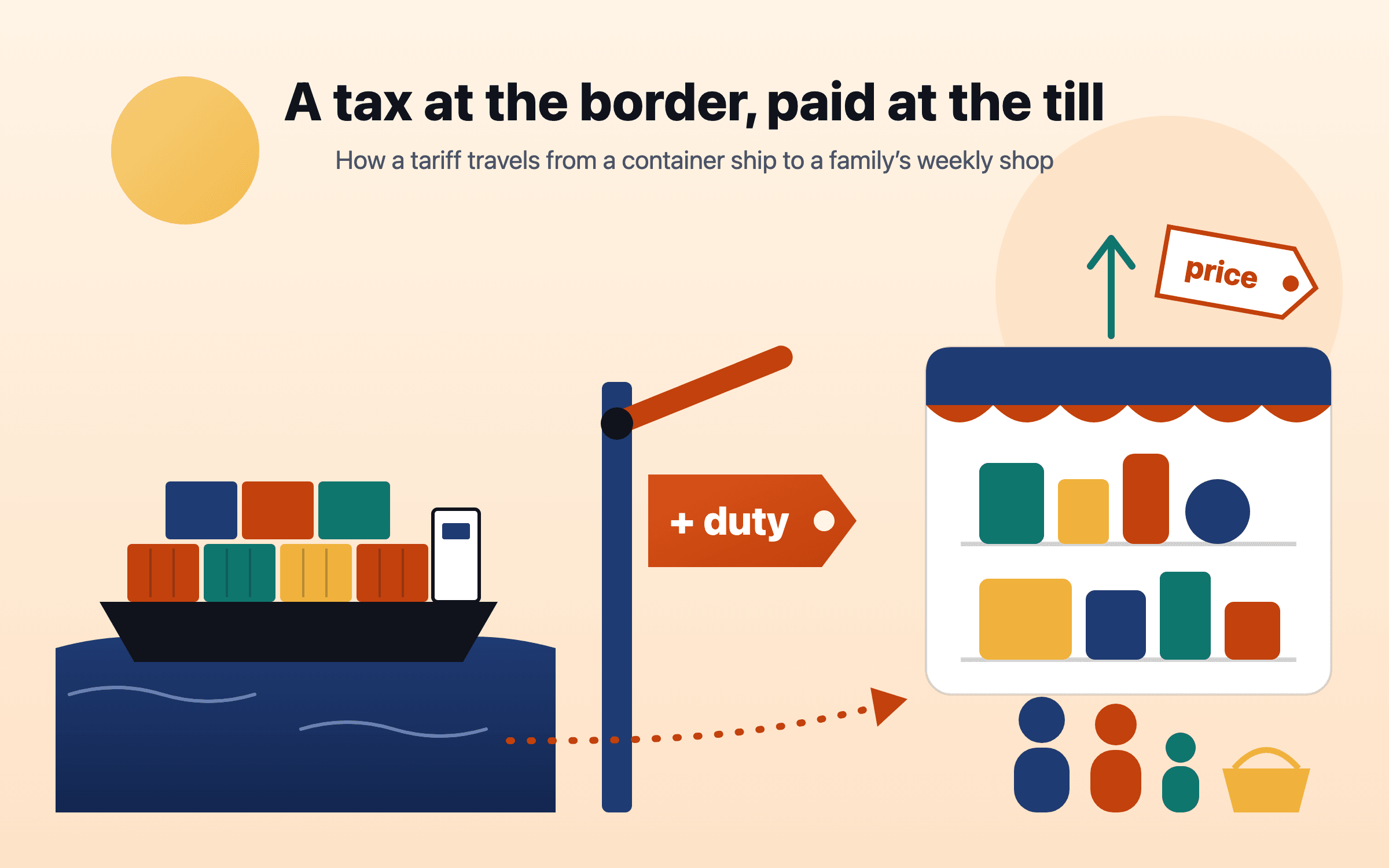
US tariffs rose in 2025 to their highest average level in about ninety years, were cut back by a Supreme Court ruling in February 2026, and were rebuilt under other laws. Research finds the cost lands mostly on buyers in the importing country, spread across importers, shops and households; Yale’s Budget Lab puts it at about $1,100 a year for the average US household. Elsewhere the effect arrives through export orders, jobs, markets and interest rates. The useful response is a budget that knows which costs are rising, a cash buffer sized to your job’s exposure, and no trading on headlines.
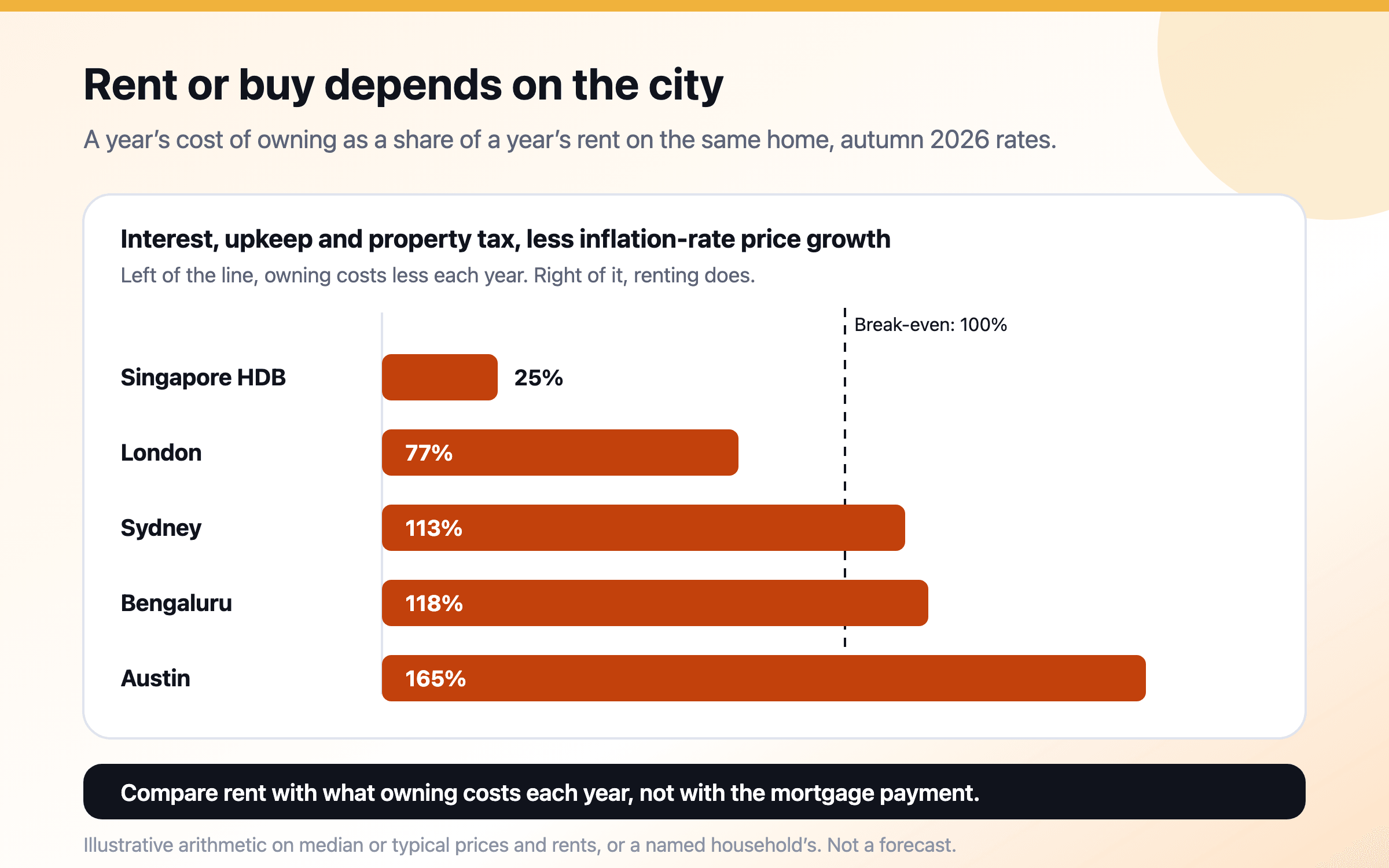
Compare rent with the unrecoverable cost of owning — interest, upkeep, property tax and the return your deposit gives up, less expected price growth — not with the mortgage payment. At autumn 2026 rates, owning the average London home costs somewhat less than renting it, an Austin home costs far more to own than to rent, and an HDB flat in Singapore costs far less. Transfer taxes then decide how long you must stay.
This is general information, not financial, tax or legal advice for your circumstances. Rules and figures change; check the official source for your country, and consult a licensed professional before making financial decisions. Projections are estimates, not predictions.