A budget written in January is a forecast, and forecasts drift. Ten minutes at the end of each month catches the drift while it is small, sees the expensive month coming and keeps the record whole.
People underestimate what lies ahead even when asked for a worst case: students in a classic study took 55.5 days over theses they expected to finish in 33.9. A yearly budget is that kind of forecast. A short check at the end of each month catches drifts while they are small, sees the irregular month coming and keeps every month on the record.
Nivritee Research · 8 November 2026 · 9 min read
The short answer: a budget written once a year is a forecast, and people forecast badly even when they try to be careful. In a classic study, students expected to finish their theses in 33.9 days and took 55.5; fewer than a third finished by their own best guess1. A household budget made in January has the same weakness, and nobody finds out until the year is over. A short check at the end of each month fixes most of it. A drift is caught after one month rather than twelve, the month with the school fees or the insurance renewal is seen coming, the plan keeps up with prices and pay as they change, and a month that was missed is carried forward rather than left blank. Field experiments find that a monthly nudge alone raises saving2.
India’s retail inflation in the year to September 2026; food prices rose 7.74%
Why a yearly budget breaks by spring
A yearly budget is usually written in one sitting, in January or at the start of the financial year, with real care. Rent, the loan, school fees, groceries, a figure for eating out and a figure for festivals. Then it goes into a drawer or a spreadsheet tab, and the next time anybody compares it with what happened is the following January. By then the budget and the year have parted company, and nobody can say in which month it happened or why.
The reason is not that families are careless. Forecasting our own future is hard in a particular, lopsided way. In 1994 the psychologists Roger Buehler, Dale Griffin and Michael Ross asked 37 final-year students when they would hand in their theses. On average their best guess was 33.9 days, their best case 27.4 days and their worst case 48.6 days. They took 55.5 days on average, longer than even the worst case, and only 29.7% finished within their best guess1. The authors called it the planning fallacy: when we plan, we picture things going as intended and leave out the interruptions that we know, from experience, will come.
How long students expected their theses to take, against how long they took, in days.
Average predictions and the average actual time for the students in Study 1 of Buehler, Griffin and Ross (1994). Even the worst-case forecast fell short of what happened. 1The figures in this chart
Days to finish
Best case
27.4 days
Best guess
33.9 days
Worst case
48.6 days
What it took
55.5 days
A household budget is a plan of exactly this kind, and it fails in the same direction. It is written on a calm day and leaves out the repair, the wedding, the price rise and the month somebody was unwell. A yearly budget is still worth having, because it is the only place the whole year is visible at once. What it cannot do is check itself. That needs a moment, every month, when what was planned meets what happened.
Small drifts build on each other
Ritu and Sameer live in Lucknow with their son, who is nine. Both work, and their take-home pay together is the same every month. Their figures in this article are illustrative and round, chosen to make the arithmetic easy to follow, not to describe a real family. In January they set their everyday spending — groceries, fuel, eating out, small shopping — at one round figure a month.
Nothing dramatic happens. A second streaming subscription, a slightly dearer brand of oil, food delivery on the evenings both of them work late. Each month the everyday line runs a little above the month before, and each new level quietly becomes normal: once delivery is a habit, next month’s small rise starts from there. That is what makes a drift compound. It does not add the same small amount each month; it adds a small share of a figure that keeps rising.
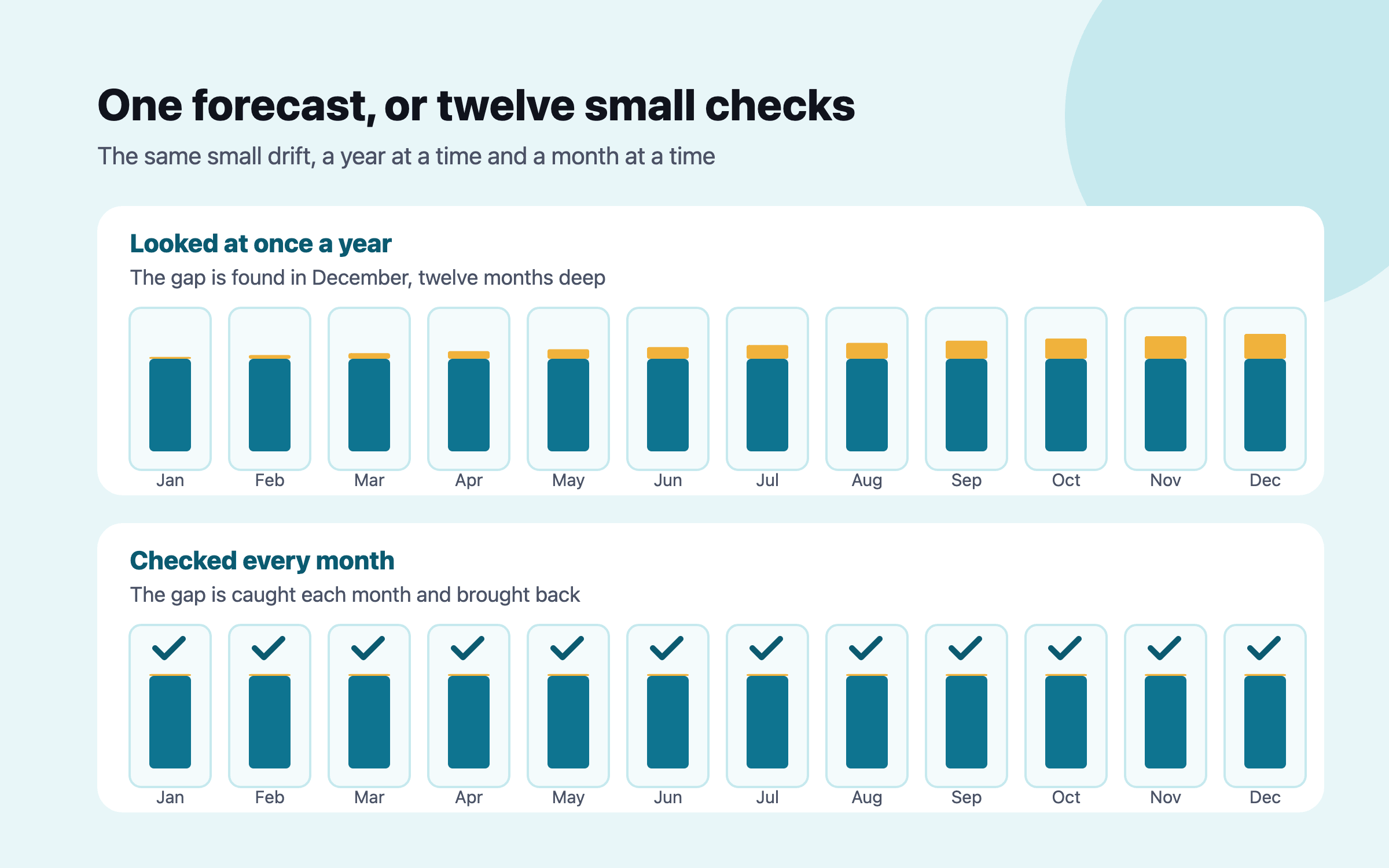
The table runs the same year twice. In both, spending creeps up by a fiftieth each month. In the first, nobody looks until December. In the second, they look at the end of each month, notice the line has crept, and bring it back to plan the next month, before the new level has had time to settle in.
Illustrative. Spending rises 2% on the month before. Looked at once a year, each month builds on the last; checked monthly, it is brought back each time and only ever runs one month’s 2% over. Rounded to the rupee.
The same drift, looked at twice
Looked at once a year
Checked every month
Everyday spending planned each month
₹40,000
₹40,000
Everyday spending in the twelfth month
₹50,730
₹40,800
Spent above the plan over the year
₹67,213
₹9,600
That overspend, in months of the planned line
1.7
0.2
Illustrative: everyday spending as a share of the plan, when a small monthly drift is left alone and when it is caught each month.
Looked at once a year
Checked every month
Illustrative. The plan is 100. Left alone, a drift of a fiftieth a month reaches more than a quarter above plan by December; caught at each month’s end, it never runs more than one month’s drift over. The figures in this chart
Looked at once a year
Checked every month
Jan
102.0%
102.0%
Feb
104.0%
102.0%
Mar
106.1%
102.0%
Apr
108.2%
102.0%
May
110.4%
102.0%
Jun
112.6%
102.0%
Jul
114.9%
102.0%
Aug
117.2%
102.0%
Sep
119.5%
102.0%
Oct
121.9%
102.0%
Nov
124.3%
102.0%
Dec
126.8%
102.0%
The difference at the end of the year is about a month and a half of the everyday line, gone without a single decision anybody would remember making. And the cost does not stop in December. A budget for the next year is usually written from the last year’s spending, so the drift becomes next January’s plan, and the creep starts again from the higher level. Lifestyle inflation and the idea of enough follows the same mechanism over a whole career.
The month that ambushes a yearly budget
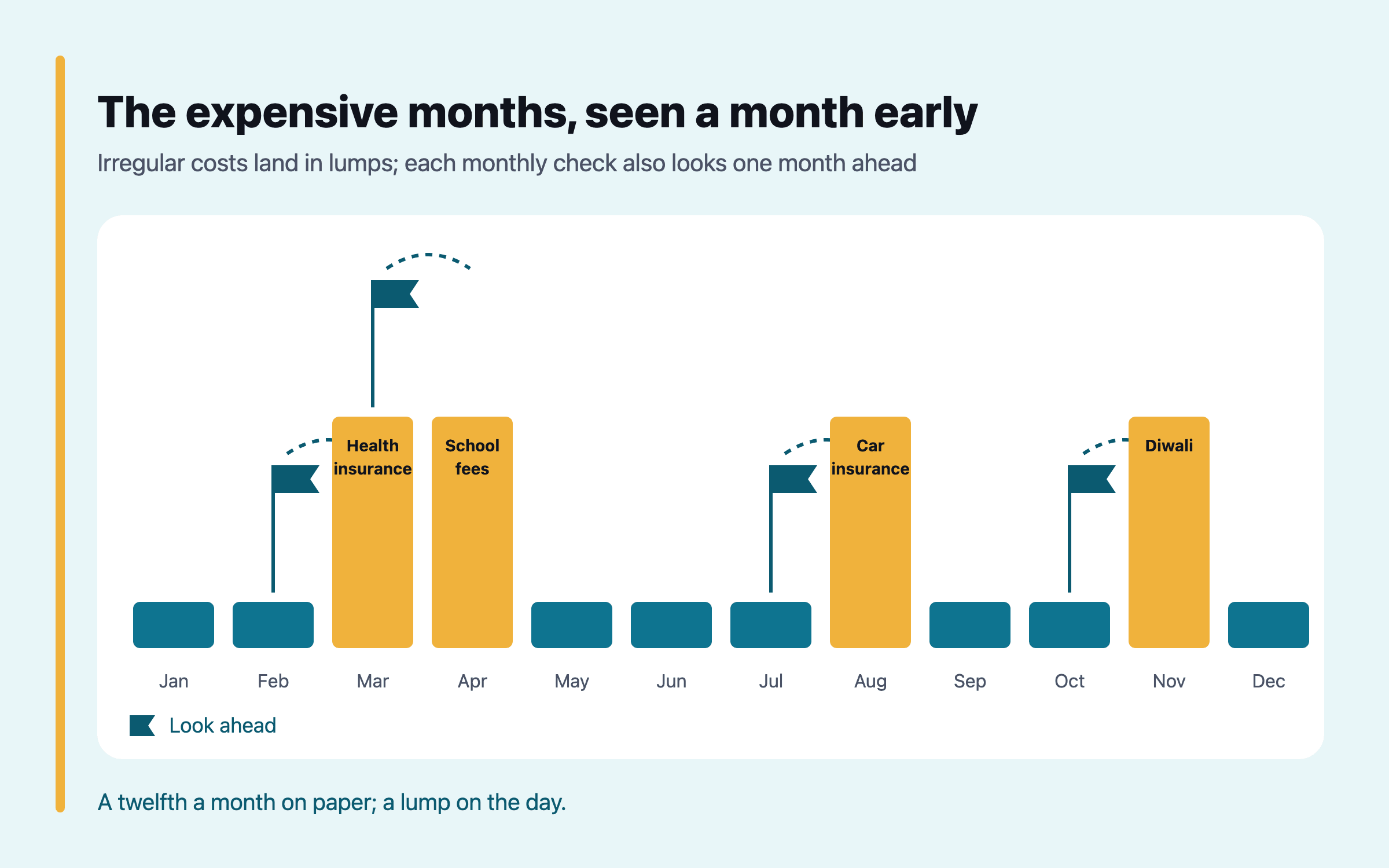
A yearly budget handles irregular costs by dividing them by twelve. That is right for the year and wrong for nearly every month in it, because the money does not leave a twelfth at a time. It leaves in lumps, and the lumps cluster. Ritu and Sameer’s year has four of them.
Illustrative. A yearly budget would carry these as ₹11,667 a month. In April the school fees alone are a third of the household’s monthly take-home pay of ₹1,50,000.
Month
What lands
Amount
March
Health insurance renewal for the three of them
₹30,000
April
School fees and books for the year
₹50,000
August
Car insurance
₹15,000
November
Diwali: gifts, clothes, sweets, travel to family
₹45,000
The other eight months
Nothing irregular
—
The year
₹1,40,000
Irregular costs arrive in lumps. A monthly check that also looks one month ahead sees each lump while there is still a month to prepare.
This is where a monthly check earns its keep. At the end of February, closing the month takes one more question: what is coming next month? The insurance renewal is then a known number with four weeks to find it, not a surprise on the day the premium is debited. Karlan, McConnell, Mullainathan and Zinman built their study on exactly this weakness. Their model has people paying full attention to this month’s spending and losing sight of lumpy costs ahead — school fees are their own example5. In their experiments with three banks, customers sent a monthly reminder saved 6% more and were 3 percentage points likelier to reach their savings goal; in Peru, a reminder that named the expense the customer was saving for raised saving by an estimated 16%, while a reminder that did not name it made no difference2.
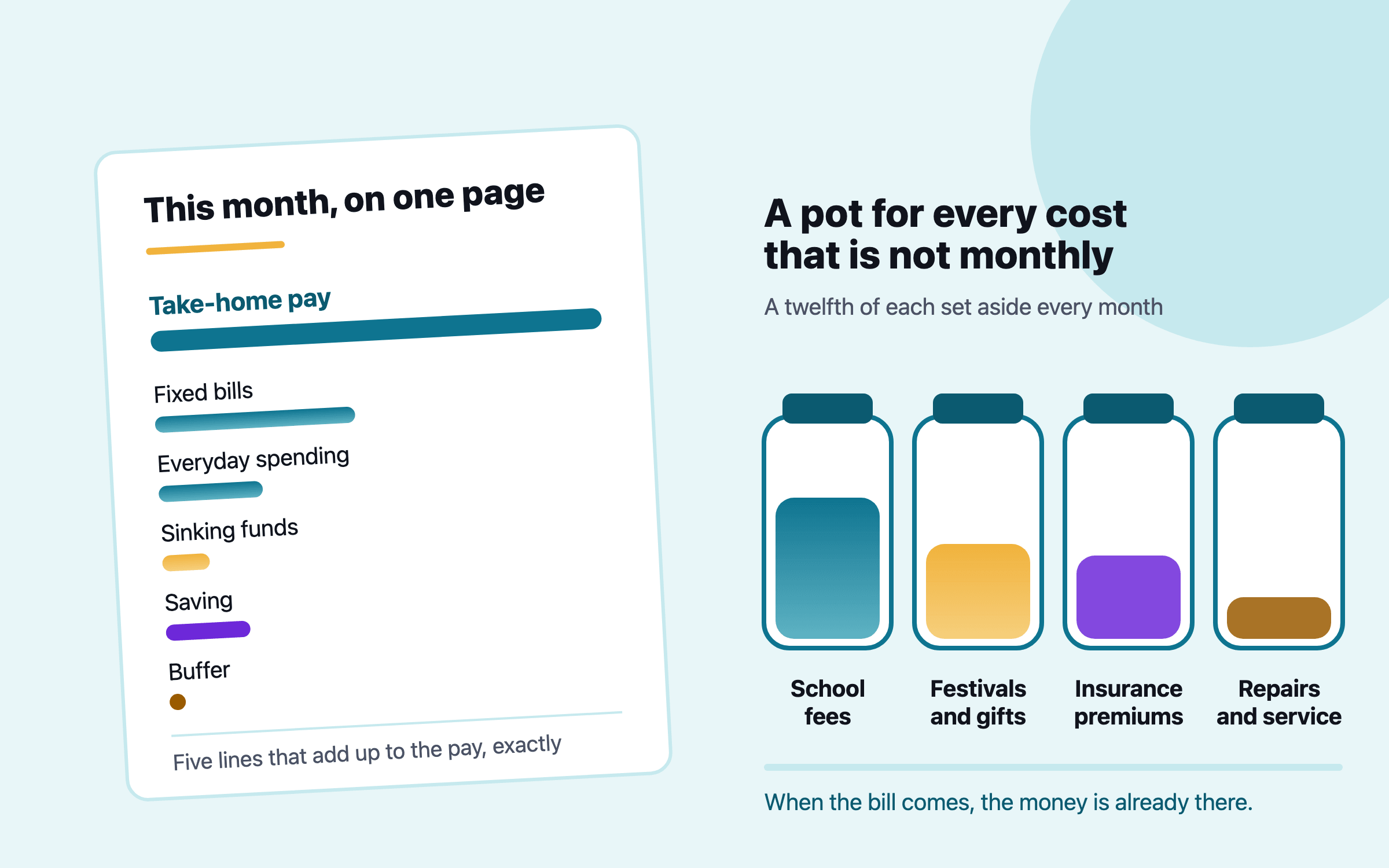
The stakes are not small. In the Federal Reserve’s survey of American adults in October 2025, 63% said they would cover an unexpected $400 expense with cash or its equivalent3 — which leaves more than a third who would borrow, sell something or not manage it. A month carrying a lump the household did not see coming is how many families end up on a credit card. The longer-term answer is a separate pot for each irregular cost, built a twelfth at a time; managing money month to month without the stress works through it. The monthly check is what keeps the pots honest, because it is when each pot is compared with the bill it is for.
A plan should follow real life
The family that wrote the budget in January is not the family living in October. Prices move: in India, retail prices rose 5.54% in the twelve months to September, and food prices 7.74%4,6, so a grocery figure set at the start of the year is already behind. Pay changes with an increment or a new job. A child changes school, a parent moves in, a car is sold. None of these waits for January.
A budget that is only revised once a year asks the household to live by an old description of itself. Most people respond by ignoring it, which is the usual end of a yearly budget. A monthly check turns the question around. Instead of asking whether this month obeyed the plan, it asks what this month actually was, and lets the plan move with it: the grocery line goes up because groceries cost more, and that change is made on purpose, written down and visible, rather than discovered as a mystery overspend in December. The plan stays useful because it stays true.
Confirming a month takes a minute
The objection to monthly tracking is time, and it is a fair one for the way many people try it: every receipt typed in, every purchase sorted into a category. That is not what a month needs. Most of a household’s month is the same as the month before. Rent, the car loan, the school bus, the help at home, the phone, the money sent to parents: those lines repeat to the rupee. So start from last month’s figures, copied forward, and do two things. Confirm the lines that did not change, and type only the ones that did.
Illustrative. Ritu and Sameer’s June and July. More than half the lines are the same to the rupee and need only a yes; five moved, and the five that moved are the ones worth a look.
Line
Last month
This month
What it took
Rent
₹30,000
₹30,000
Confirmed
Car loan EMI
₹14,000
₹14,000
Confirmed
Support to Sameer’s parents
₹8,000
₹8,000
Confirmed
Help at home
₹6,000
₹6,000
Confirmed
School bus
₹3,000
₹3,000
Confirmed
Phone and internet
₹1,500
₹1,500
Confirmed
Subscriptions
₹1,000
₹1,000
Confirmed
Groceries
₹17,500
₹18,200
Typed
Fuel and travel
₹6,000
₹6,600
Typed
Eating out and delivery
₹5,000
₹7,100
Typed
Small shopping and medicines
₹7,200
₹4,200
Typed
Electricity
₹2,800
₹3,400
Typed
The month
₹1,02,000
₹1,03,000
7 confirmed, 5 typed
That takes a few minutes, and the few minutes are mostly spent where they should be: on the lines that moved. Eating out jumped by about two-fifths, which is worth a sentence between the two of them; small shopping fell, which may be a real saving or a bill not yet paid. The check also does something a spreadsheet cannot do on its own. It makes the household look. Victor Stango and Jonathan Zinman found that bank customers who were simply asked survey questions about overdraft fees were less likely to run up a fee in the month they were asked, and that being asked repeatedly built up attention that kept overdrafts down for up to two years7. A regular question about money changes behaviour because it is a question, before any answer is analysed.
A carried month beats a gap
Every household misses a month sooner or later. A wedding season, an illness in the family, a busy quarter at work. In Ritu and Sameer’s year it is July to September, when Sameer’s father was in hospital and nobody wrote anything down. What they do about those months when they come back matters more than the fact that they missed them.
Leaving the months blank looks harmless, and it is the worst choice. A blank month reads as a month in which nothing was spent. Income still arrived, so the year’s figures say the household saved far more than it did. The better choice is to carry the last month they did record — June — forward into each missed month, mark the three as carried, and correct any line they later remember. A carried month is wrong by a little, because spending moves a little; a blank month is wrong by the whole month.
Illustrative. Take-home pay of ₹1,50,000 a month, ₹18,00,000 for the year, and the year’s irregular costs of ₹1,40,000 in every row. Monthly spending rose from ₹98,000 in January to ₹1,06,000 in December; June was ₹1,02,000.
Ritu and Sameer’s year
Everyday and fixed spending
Saved, after irregular costs
Savings rate
What really happened
₹12,28,000
₹4,32,000
24.0%
July to September left blank
₹9,17,000
₹7,43,000
41.3%
July to September carried from June
₹12,23,000
₹4,37,000
24.3%
Illustrative: the same year’s savings rate, recorded three ways.
Illustrative. Three blank months make the year look like a far better one than it was. Carrying the last recorded month forward lands within a fraction of a point. The figures in this chart
Savings rate
What really happened
24.0%
Three months left blank
41.3%
Three months carried forward
24.3%
The blank version is not just a little off. It reports a household saving two-fifths of its pay when it saved about a quarter, and every decision taken from that figure — a bigger loan, a holiday, a smaller monthly investment — rests on money that was in fact spent. A carried month says plainly that it is an estimate, sits close to the truth, and can be corrected later if a statement turns up. The rule is the same for a single missed week inside a month and for a whole quarter: carry, mark, correct, and never leave a hole that reads as zero.
A ten-minute monthly check, step by step
Pick one evening at the start of each month and keep it. The first few times take longer; after that it is ten minutes or so, and both partners can do it together, which is half the value.
Copy last month forward. Start from the month just gone, with every line as it was the month before.
Confirm what repeated. Rent, loans, school transport, subscriptions, transfers: a yes for each one that is the same.
Type what moved, from the bank and card statements, and look twice at any line that moved a lot.
Look one month ahead. Name any irregular cost due next month and check that its pot holds enough.
Let the plan move on purpose. If a line is higher because life changed — prices, a new school, a raise — change the plan and write down why.
Carry what you missed. If a month was skipped, copy the last recorded month into it, mark it as carried and correct it when you can.
None of this needs a new budgeting method; budgeting methods compared sets out the main ones, and the monthly check works with any of them. It does not replace the yearly look either. Once a year is still the right time for the larger questions — whether the emergency fund is big enough, as how big an emergency fund should be works through, and whether saving is on course for the long goals. The difference is that the yearly look now starts from twelve true months rather than one old forecast.
Questions people ask
Is a monthly budget better than a yearly budget?
They do different jobs. A yearly budget shows the whole year at once and is where irregular costs are planned; a monthly check compares what happened with the plan while there is still time to act. A yearly budget that is never checked during the year tends to drift, because people underestimate what lies ahead even when they try to be careful.
Why do yearly budgets fail?
They are a forecast made once, on a calm day, and forecasts leave out interruptions: repairs, price rises, illness, a lumpy month. By the time the budget is compared with the year, the gap has grown for twelve months and nobody can say when it started.
How long should a monthly money check take?
About ten minutes once it is a habit. Start from last month’s figures, confirm the lines that repeated, type only the ones that changed, and look one month ahead for any irregular cost.
What should I do if I missed tracking a month?
Do not leave it blank. A blank month reads as a month with no spending and makes the year look better than it was. Copy the last month you did record into the missed one, mark it as carried, and correct it when you find the statements.
How do I budget for irregular expenses like school fees and insurance?
List each one with its month and amount, divide the year’s total by twelve and set that aside every month in a separate pot. At each monthly check, look one month ahead and compare the next bill with what its pot holds.
In the APA’s 2026 survey 77% of US adults called the cost of living a significant source of stress, and September prices rose 3.7% in the US and 5.54% in India. A Mumbai family shows the fix: one page for the month, a pot for every irregular cost, payday automation and twenty minutes a week.
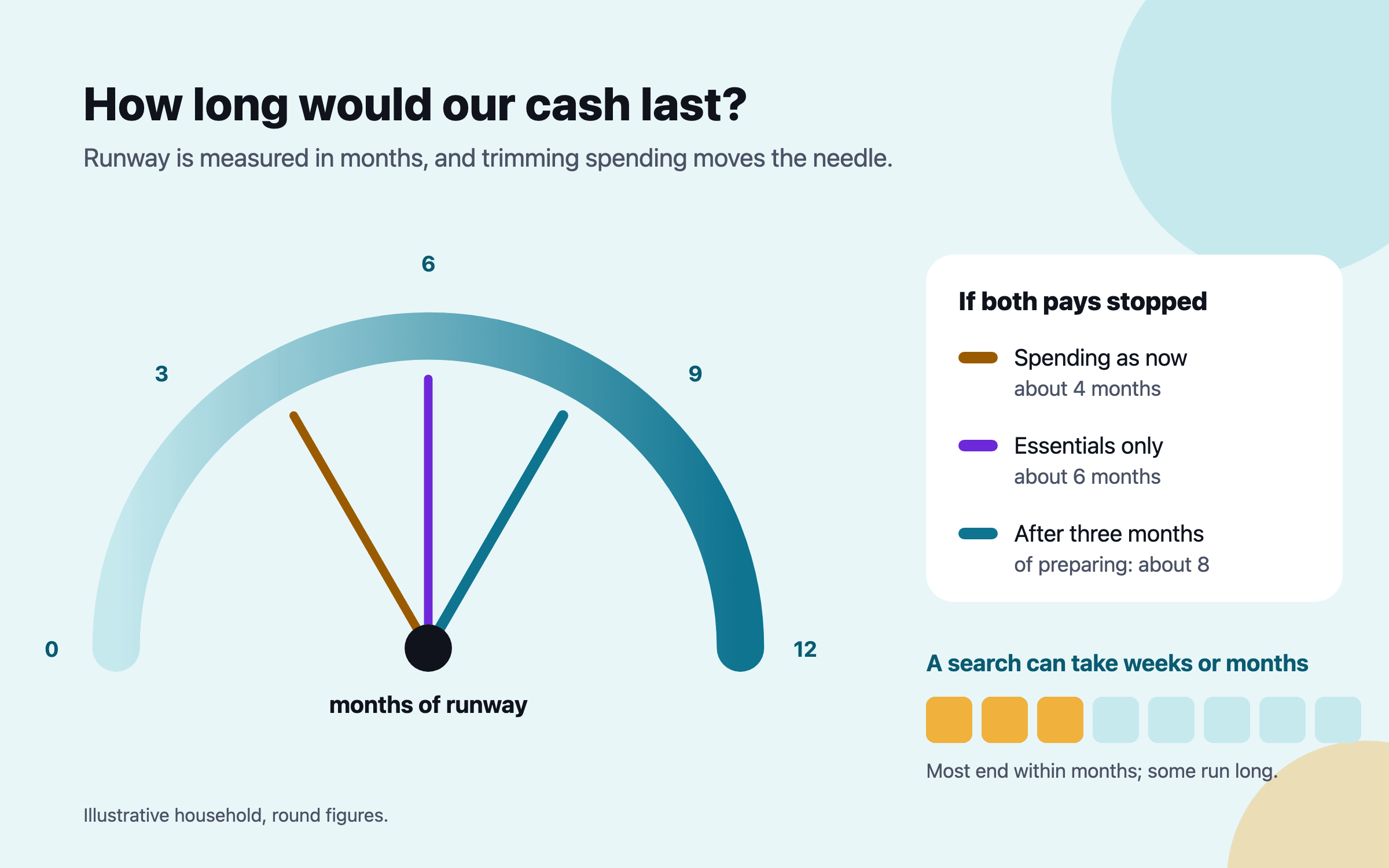
US employers announced 43,281 job cuts in September 2026 and technology led every sector, while India’s big IT firms moved in opposite directions. If your job is the one people are whispering about, the useful work is done before any notice arrives: count your runway in months, plan your cuts in order, check your contract and cover, and talk it through at home.
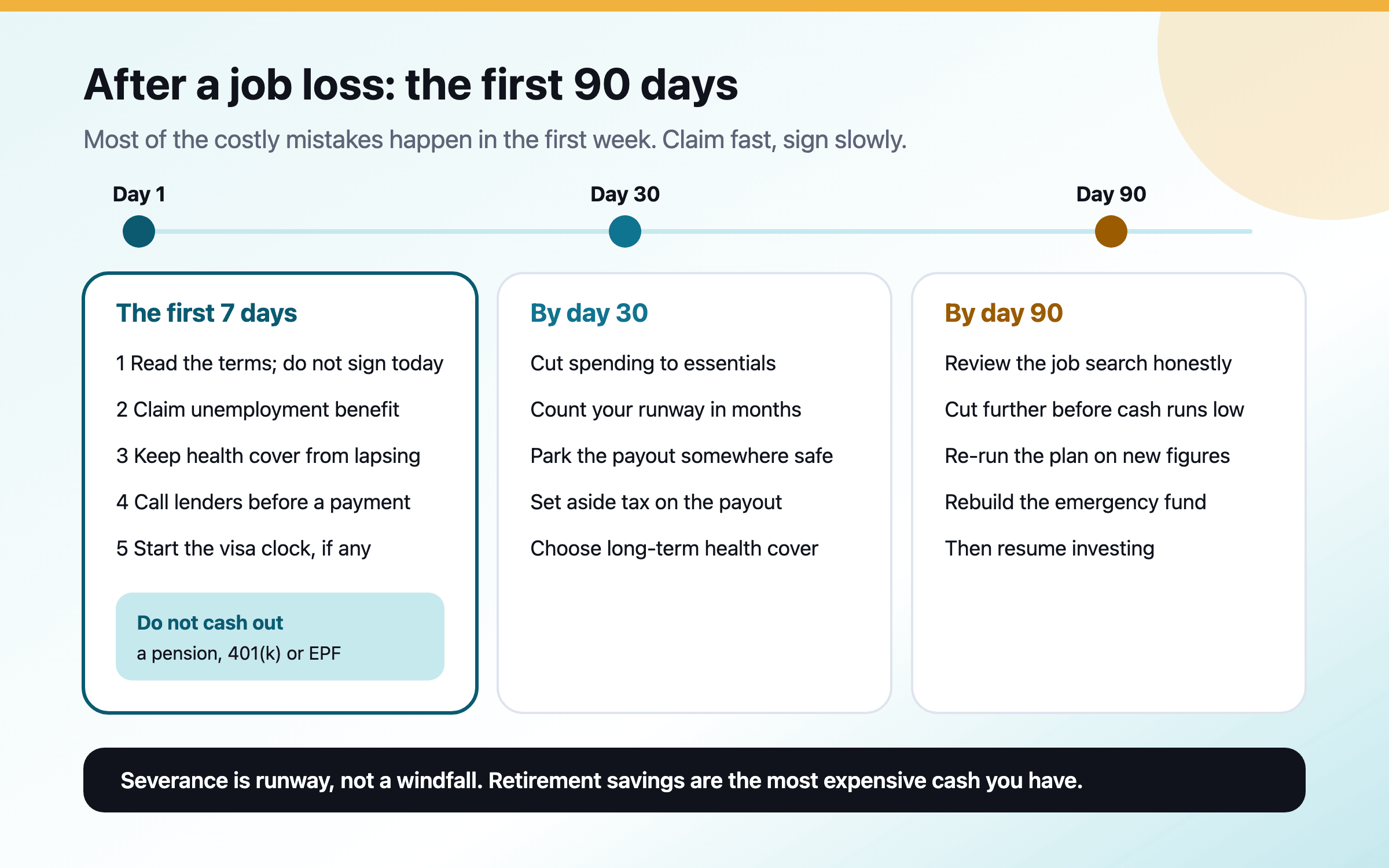
Most of the expensive mistakes after a layoff happen in the first fortnight: signing a severance agreement unread, claiming benefits late, letting health cover lapse, missing a loan payment without calling the lender, and cashing out retirement savings. This is the order to do things in, with the 2026 rules for the US, UK, India, Canada, Australia, Singapore and the UAE.
This is general information, not financial, tax or legal advice for your circumstances. Rules and figures change; check the official source for your country, and consult a licensed professional before making financial decisions. Projections are estimates, not predictions.